

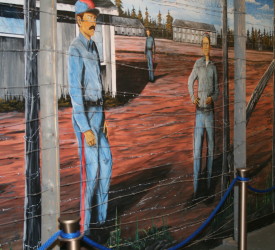
Located in Minto, New Brunswick, the New Brunswick Internment Camp Museum shares a powerful and often overlooked chapter of Canadian history. It is one of only two museums in Canada dedicated solely to the internment of POWs during the Second World War, and the only site of its kind in the Maritimes.
The museum features a collection of 700+ artifacts, including original artwork, handcrafted tools, and personal items that provide insight into daily life and resilience during internment.
This important site began as a program for at-risk students led by teacher Ed Caissie (1993/94) and has grown into a meaningful space for education, reflection, and remembrance.
Phase I (1940–1941)
The camp initially held 711 German and Austrian Jewish internees. One notable figure was Fritz (Frederich) Bender, an inventor who later contributed to the development of waterproof plywood used in the Mosquito bomber.
Phase II (1941–1945)
The camp later housed nearly 1,200 POWs, primarily German and Italian Merchant Marines. Among them was Camillien Houde, Mayor of Montreal, who was interned for three and a half years due to his opposition to certain Canadian government policies.
May 18 – September 5, 2026:
Admission:
420 Pleasant Drive, Unit 1 Minto, New Brunswick, E4B 2T3